AI Build Desk covers custom AI chatbots, AI agents, and AI-powered applications for businesses without an in-house AI team.
3 stories
·
0 followers

GPT Vs Claude Integration: Which Fits Your Use Case

1 Share

GPT vs Claude Integration: Which Fits Your Use Case depends on your workload, model version, and operating constraints. OpenAI and Anthropic both provide APIs, while cited context figures range from Claude’s 200,000 tokens to GPT-4.1’s 1,047,576 tokens. Compare quality, latency, validation behavior, security requirements, and total cost on representative tasks before production.

  • OpenAI provides an API for embedding ChatGPT in custom applications.
  • Claude offers API access for tailored enterprise solutions.
  • GPT-4.1 is listed at $2 per million input tokens and $8 per million output tokens.
  • Claude Sonnet is listed at $3 per million input tokens and $15 per million output tokens.
  • GPT-4.1 is listed with a context window of 1,047,576 tokens.

What do GPT and Claude offer for API and application integration?

GPT vs Claude Integration: Which Fits Your Use Case depends first on whether you need an API, developer tooling, or a hosted platform. OpenAI provides an API for embedding ChatGPT in custom applications, while Anthropic provides API access for tailored enterprise solutions.

GPT vs Claude Integration: Which Fits Your Use Case also includes the surrounding development workflow. Both model families integrate with coding tools; ChatGPT offers extensions for VS Code, Jupyter, and JetBrains, while Advanced Data Analysis can run Python, create visualizations, and help with debugging. Claude Code CLI lets developers run tasks directly from a terminal, and Claude is available through Amazon Bedrock and Google Vertex AI.

GPT vs Claude Integration: Which Fits Your Use Case is most practical when you define the application boundary clearly: a customer-support bot, a retrieval-augmented generation knowledge system, or another custom AI application. RAG supplies relevant business content alongside the current conversation instead of requiring the whole knowledge base in every request.


What do GPT and Claude offer for API and application integration?

Learn more about the GPT Vs Claude Integration: Which Fits Your Use Case here.

Which integration features—such as tool calling, structured outputs, vision, and multimodal input—are available in GPT and Claude models?

GPT vs Claude Integration: Which Fits Your Use Case should be evaluated at the model-version level, not only by provider name. OpenAI’s API includes function calling and JSON-schema structured outputs, while both APIs support external function calls in which a model selects a tool, returns arguments, and receives the tool result.

GPT vs Claude Integration: Which Fits Your Use Case includes streaming, vision, and multimodal inputs in both API families, although the cited capabilities differ by model. Claude Sonnet and Opus accept text and image input; GPT-4.1 and o3 accept text, voice, and image input.

GPT vs Claude Integration: Which Fits Your Use Case also differs in media output. Claude can inspect uploaded images but doesn’t natively generate images, audio, or video, while GPT-4o is described as handling and generating text, images, audio, and video.

For structured extraction, OpenAI uses response_format with json_schema, while Claude uses a tool definition with input_schema and tool_choice. OpenAI supports streaming structured output; Anthropic tool-use blocks arrive complete in one content-block-stop event.

Which integration features—such as tool calling, structured outputs, vision, and multimodal input—are available in GPT and

How do GPT and Claude compare in API pricing, context-window limits, rate limits, and latency?

GPT vs Claude Integration: Which Fits Your Use Case has no single price because models and traffic patterns differ. The cited examples list GPT-4.1 at $2 per million input tokens and $8 per million output tokens, compared with Claude Sonnet at $3 and $15.

GPT vs Claude Integration: Which Fits Your Use Case also changes with context requirements. GPT-4.1 is listed at 1,047,576 tokens, while Claude Sonnet and Opus are listed at 200,000 tokens. Another comparison lists GPT-5 input at $1.25 per million tokens and Claude Sonnet 4.5 at $3.

GPT vs Claude Integration: Which Fits Your Use Case requires workload testing for limits and speed. OpenAI is described as offering more granular rate-limit controls; both providers use tiered limits, and Anthropic may throttle parallel requests more aggressively.

GPT vs Claude Integration: Which Fits Your Use Case can’t be priced from list rates alone. Input/output ratios, caching, retries, prompt size, latency, and infrastructure affect total cost, and the ledger provides no universal latency figure. The cited comparison says GPT-4.1 and Sonnet offer better speeds than the more powerful o3 and Opus pair.

How do GPT and Claude compare in API pricing, context-window limits, rate limits, and latency?

GPT vs Claude Integration: Which Fits Your Use Case for customer support, coding, document analysis, and content generation?

GPT vs Claude Integration: Which Fits Your Use Case depends on the work you need the application to perform. Sources recommend ChatGPT for rapid prototyping, creative problem solving, development-tool integration, high-volume general FAQs, blog posts, ad copy, scripts, app building, debugging, and step-by-step logic explanations.

GPT vs Claude Integration: Which Fits Your Use Case may favor Claude for large codebases, detailed code reviews, long-document analysis, complex technical support, and creative writing. Claude is also described as suitable for lengthy contracts and research materials.

GPT vs Claude Integration: Which Fits Your Use Case has no universal coding winner in the cited evidence. One evaluation reports Claude Opus 4.6 at 80.8% on SWE-bench Verified and GPT-5.2 at 80.0%; another names Sonnet the winner for design and code.

A hybrid workflow can route tasks by reasoning requirements, latency, workload volume, and operating cost. OpenAI says teams can combine GPT-6 Luna, Sol, and Astra in one application, which provides a model-routing pattern rather than a reason to select one model for every task.

GPT vs Claude Integration: Which Fits Your Use Case for customer support, coding, document analysis, and content generation?

How can a team integrate GPT or Claude into an existing application, and what setup steps are required for each API?

GPT vs Claude Integration: Which Fits Your Use Case can follow one shared application pattern: authenticate with an API key, select a model, pass the conversation and retrieved business content, validate the response, and connect approved tool calls to application actions. RAG is appropriate for support bots and knowledge systems because it retrieves relevant content instead of sending an entire knowledge base with every conversation.

  1. Install the OpenAI or Anthropic TypeScript SDK; both named SDKs provide TypeScript typings.
  2. For OpenAI extraction, use response_format with json_schema; for Claude, define a tool with input_schema and set tool_choice.
  3. Validate responses in application code before passing data downstream.
  4. Pin a production model version, log inputs, raw responses, parsed results, and validation errors, and cap validation retries at three attempts.
  5. Split oversized source text into chunks, extract from each chunk, and merge the results in application code.

GPT vs Claude Integration: Which Fits Your Use Case should therefore be treated as an application lifecycle, not only an API call. The ledger doesn’t provide build-cost or delivery-time ranges for an integration project.


GPT Vs Claude Integration: Which Fits Your Use Case

Click to view the GPT Vs Claude Integration: Which Fits Your Use Case.

What security, data-retention, reliability, and vendor lock-in trade-offs should teams assess before choosing?

GPT vs Claude Integration: Which Fits Your Use Case requires configuration-specific security review. Anthropic is reported not to use conversations to train future models by default, but the available evidence doesn’t establish equivalent retention, residency, or training policies for every GPT and Claude API configuration.

GPT vs Claude Integration: Which Fits Your Use Case should also account for connected-service permissions. Permissions can be scoped, and a calendar connection doesn’t automatically grant access to Gmail or Drive unless those services are separately connected.

GPT vs Claude Integration: Which Fits Your Use Case can create dependence on provider-specific model names, structured-output formats, tool schemas, SDKs, and hosted platforms. OpenAI’s response_format and Anthropic’s tool_use are different structured-output approaches, and the ledger provides no quantified vendor-lock-in or uptime comparison.

Claude is listed as available through Amazon Bedrock and Google Vertex AI, while GPT-6 Astra can be accessed through Amazon Bedrock APIs. The available evidence doesn’t provide a complete security, compliance, data-residency, reliability, or rollback comparison, so you’ll need provider-specific review and fallback planning.

How should a team benchmark both integrations against its own tasks, quality targets, and total operating cost before production?

GPT vs Claude Integration: Which Fits Your Use Case should be decided with representative workload evidence rather than a general reputation. Run both models side by side on real tasks and measure output quality, response time, and required manual adjustment.

  1. Prepare representative prompts and compare how often each model produces an acceptable output for your workload.
  2. For customer support, use actual customer queries and compare factual accuracy, customer satisfaction, escalation rate, and resolution time.
  3. Test structured-schema changes against at least real inputs before deployment.
  4. Calculate total cost from actual input/output ratios, caching, retries, rate limits, and infrastructure rather than list prices alone.

GPT vs Claude Integration: Which Fits Your Use Case should end with a task-specific recommendation: one model may suit general FAQs while another suits complex technical support, but the ledger doesn’t provide a universal winner, uptime figure, or production latency target. AI Build Desk can use this kind of brief to clarify a custom chatbot or RAG knowledge-system project, but no project price or timeline is provided here.

See the GPT Vs Claude Integration: Which Fits Your Use Case in detail.

API input and output prices by model (compiled from sources)
Model Input price Output price
GPT-5 $1.25 per million tokens $10 per million tokens
Claude Sonnet 4.5 $3 per million tokens $3.75 per million tokens
GPT-4.1 $2 per 1M input tokens $8 per 1M output tokens
GPT-4o $2.50 per million input tokens $10.00 per million output tokens
Claude Sonnet 4.6 $3.00 per million input tokens $15.00 per million output tokens
GPT-5.6 Terra $2 per million input tokens $12 per million output tokens
Claude Sonnet 5 $2 per million input tokens $10 per million output tokens
Context window sizes by model or product (compiled from sources)
Model or product Context window
GPT-5 400K tokens
Claude up to 200K tokens
GPT-4.1 Turbo up to 1,000,000 tokens
Claude Pro 200K-token context window
ChatGPT Plus 128K-token context window
GPT-4.1 1,047,576 tokens
GPT-4o 128k-token context window
Claude Sonnet 4.6 200k-token context window
Claude Opus 4.6 200k-token context window
Claude Sonnet 5.5 one-million-token context window

Key Takeaways

  • Use API access and RAG when building customer-support bots or business knowledge systems.
  • Choose model versions based on required tools, structured outputs, context size, and media capabilities.
  • Validate structured responses, cap retries at three, log calls, and pin a production model version.
  • Benchmark both providers with representative prompts and actual customer queries before choosing.
  • Treat security, retention, residency, reliability, rollback, and vendor lock-in as configuration-specific review areas.

Frequently Asked Questions

Which is cheaper for API integration, GPT or Claude?

GPT-4.1 is listed at $2 per million input tokens and $8 per million output tokens, while Claude Sonnet is listed at $3 and $15. Actual operating cost also depends on token ratios, caching, retries, prompt size, latency, and infrastructure.

Can GPT and Claude handle multimodal inputs?

Both OpenAI and Anthropic APIs support streaming, function calling, vision, and multimodal inputs, although supported capabilities differ by model version.

Which is better for coding and software development?

Claude is recommended for large codebases, detailed code reviews, and long-document analysis, while ChatGPT is recommended for rapid prototyping, development-tool integration, and creative problem solving. A task-specific benchmark remains necessary.

How do you integrate GPT or Claude into a customer-support chatbot?

Use retrieval-augmented generation to retrieve relevant business content and provide it with the current conversation instead of sending an entire knowledge base every time. The same setup pattern can work with GPT and Claude.

What security and data-retention differences should enterprises assess?

No complete security, compliance, data-residency, reliability, or rollback comparison is provided in the available evidence. Anthropic is reported not to use conversations to train future models by default, but policies can vary by configuration.


<a href="https://ebbuapp.com" rel="nofollow">https://ebbuapp.com</a>
via AI Build Desk <a href="https://ift.tt/jZfi7K4" rel="nofollow">https://ift.tt/jZfi7K4</a> October 18, 2026 at 08:51AM
Read the whole story
ebbuapp
2 days ago
reply
United States
Share this story
Delete

Best RAG Tools And Platforms Compared

1 Share

Best RAG Tools and Platforms Compared depends on the pipeline stage and deployment need: LangChain and LangGraph support modular orchestration, Chroma supports local prototyping, Milvus manages distributed vector workloads, Galileo combines five RAG functions, and evaluation tools such as RAGAS measure retrieval and generation quality. Milvus is documented for billions of vectors.

  • Standard RAG combines a retriever and a generator.
  • Galileo combines chunking, embedding, retrieval, generation, and evaluation in one platform.
  • Milvus scales across distributed clusters to manage billions of vectors.
  • Sentence Transformers can run locally without external API dependencies but require infrastructure management and GPU resources for reasonable performance.
  • RAGAS provides metrics for context precision, recall, faithfulness, and relevance.

What is a RAG tool or platform, and which parts of the retrieval-augmented generation pipeline does it provide?

Retrieval-Augmented Generation (RAG) combines a retriever with a generator: the retriever searches a knowledge base, and the generator uses retrieved evidence to craft a response. For Best RAG Tools and Platforms Compared, the practical question is which pipeline stages a product supplies.

The stages include document ingestion, text chunking, embeddings, vector indexing, semantic similarity search, retrieval, prompt augmentation, and generation. A vector database identifies semantically similar sources for a query.

LangChain is a framework for implementing RAG, not a direct alternative to RAG itself. Galileo illustrates broader platform scope by combining chunking, embedding, retrieval, generation, and evaluation. That distinction matters in Best RAG Tools and Platforms Compared: one tool may orchestrate components, while another supplies storage or evaluation. Use Best RAG Tools and Platforms Compared as a scope check, not as a claim that every product covers the entire pipeline.

What is a RAG tool or platform, and which parts of the retrieval-augmented generation pipeline does it provide?

Which are the Best RAG Tools and Platforms Compared across the pipeline?

The Best RAG Tools and Platforms Compared depend on whether you need ingestion, storage, orchestration, evaluation, or monitoring. LangChain supplies document loaders for files, websites, databases, and services; LangGraph structures pipelines with retrieval, LLM calls, agent actions, and logic.

Tool Primary role Ingestion or indexing Retrieval Orchestration Evaluation Monitoring Deployment model
LangChain Framework Loaders Integrations Modular External needed External needed Framework
LangGraph Workflow orchestration Not specified Retrieval nodes Nodes and logic Not specified Not specified Framework
LlamaIndex Indexing and retrieval 300+ integration packages Supported Not specified Modules Not specified Framework
RAGFlow RAG framework Document understanding Supported Not specified Not specified Not specified Self-hosted, open source
Haystack Modular framework Multiple stores Retrieval models Modular Analytics Not specified Open source
Dify Application platform Not specified Not specified Not specified Not specified Performance insights Not specified
Galileo Full RAG platform Chunking and embedding Supported Generation Precision, recall, coverage Latency and quality Platform
Pinecone Managed vector database Managed indexing Vector retrieval Not specified Not specified Not specified Managed
Weaviate Vector database Indexing Vector search Not specified Not specified Not specified Self-hosted option
Chroma Vector database Local storage Vector, full-text, metadata Not specified Not specified Not specified Open source and local
Milvus Vector database Distributed indexing Vector retrieval Not specified Not specified Not specified Distributed clusters
Zilliz Cloud Managed vector database Multiple index types Hybrid filtering Not specified Not specified Not specified Managed cloud
FAISS Retrieval library Fine-grained indexes Similarity search Not specified Not specified Not specified Embedded or offline
DataStax RAGStack RAG solution Uses components Supported LangChain and LlamaIndex Not specified Not specified Open source

These Best RAG Tools and Platforms Compared show why a modular stack can differ from an all-in-one product. LangChain lacks built-in evaluation and real-time observability, so external services are required. Hybrid retrieval can combine dense vectors with BM25 sparse keyword search, rerank a larger result set with a cross-encoder, and pass only the top 3–5 results to the LLM.

For Best RAG Tools and Platforms Compared, the table records only capabilities supported by the ledger; unlisted features remain unknown.

Which are the Best RAG Tools and Platforms Compared across the pipeline?

Which RAG tools are best for rapid prototyping, enterprise deployments, or self-hosted applications?

The Best RAG Tools and Platforms Compared by use case separates local prototypes from managed scale and self-hosted control. Chroma is designed for local development and prototyping, storing data locally without external dependencies. LangChain supports major vector stores, LLM APIs, and data sources, and the cited article says teams can build prototypes in hours rather than weeks.

RAGFlow is a self-hosted, open-source framework based on document understanding. Weaviate's self-hosted option gives you control over data flow and processing for data-residency or custom-routing needs. FAISS is a library rather than a database and suits embedded or offline use. Qdrant is characterized as simple to deploy for small-to-mid-scale workloads.

Milvus scales across distributed clusters to manage billions of vectors, while Zilliz Cloud supports billions of vectors and scalar-plus-vector hybrid filtering. ChatBees Serverless RAG connects PDFs, CSVs, websites, GDrive, Notion, and Confluence, with deployment and maintenance not requiring DevOps expertise. The Best RAG Tools and Platforms Compared guide therefore points to Best RAG Tools and Platforms Compared as a selection matrix: choose local simplicity, deployment control, or distributed capacity according to your project.

Which RAG tools are best for rapid prototyping, enterprise deployments, or self-hosted applications?

What pricing models, usage limits, and infrastructure costs should buyers compare?

The Best RAG Tools and Platforms Compared on price must include more than a database subscription. Compare embedding, vector storage, retrieval, reranking, LLM inference, observability, hosting, and engineering or operations; RAG can have higher implementation costs than using an LLM alone.

Pinecone uses usage-based pricing, which the cited article says can become expensive at scale. Cohere is described as offering more predictable enterprise pricing than usage-based competitors. BentoML's free tier allows deployment of one model, while MyScaleDB offers new users free storage for up to million vectors. Current prices and usage limits for most named RAG platforms aren't provided here, so verify live commercial terms.

Sentence Transformers can run locally without external API dependencies, avoiding ongoing API costs, but require infrastructure management and GPU resources for reasonable performance. Open-source LLMs can also require GPUs and specialized infrastructure. Reported custom-system estimates range from $750,000–$1,000,000 for the company-data component, $600,000–$1.5 million for one custom AI agent, and $350,000–$820,000 per year for maintenance. For Best RAG Tools and Platforms Compared, the Best RAG Tools and Platforms Compared cost question is therefore total cost of ownership, not only API price.

What pricing models, usage limits, and infrastructure costs should buyers compare?

How can a team evaluate and choose a RAG stack based on data sources, scale, latency, security, and deployment requirements?

The Best RAG Tools and Platforms Compared for your project should begin with the data, not the model. Check whether sources are clean, current, and organized; plan ingestion, cleaning, continuous updates, APIs, and pre-built connectors. For Best RAG Tools and Platforms Compared, document volume and query volume matter because scalability guidance specifically addresses millions of documents and high query volumes.

  1. Measure expected document and query volumes against latency requirements.
  2. Plan regular vector-database updates so deployed systems receive current information.
  3. Apply access filters during retrieval rather than after retrieval.
  4. Compare role-based access and deployment modes; Kernel Memory supports standalone API, embedded, Azure Kubernetes Service, and Functions deployments.
  5. Assess LLM cost, privacy, scalability, context-window limits, freshness, latency, and retrieval quality.

Milvus is documented for distributed clusters managing billions of vectors. Citation quality, deletion propagation, multimodal inputs, and source attribution should be acceptance-test topics where supported; comparative evidence for most such capabilities is unknown. Use Best RAG Tools and Platforms Compared as a requirements exercise, not a substitute for testing your own data.

Best RAG Tools And Platforms Compared

What are the trade-offs between an all-in-one RAG platform and a modular open-source stack?

The Best RAG Tools and Platforms Compared trade-off is coverage versus control. Galileo combines chunking, embedding, retrieval, generation, and evaluation in one platform. A modular stack can combine frameworks, vector databases, retrievers, LLMs, and observability tools, while Haystack is described as a modular and extensible framework for those integrations.

Modularity can support customization, but Agentic RAG requires dedicated expertise in AI, machine learning, and complex software engineering. LangChain's lack of built-in evaluation and real-time observability means external services may be needed.

Managed and self-hosted choices also differ. Pinecone abstracts index tuning but offers less fine-grained control over hybrid queries, whereas Weaviate's self-hosted option provides data-flow control. External LLM APIs add complexity, possible latency, and credential-management requirements. A hybrid approach can combine managed infrastructure and compute with open-source components, integrations, business logic, and proprietary knowledge. The Best RAG Tools and Platforms Compared decision should therefore reflect your team's skills and controls. For Best RAG Tools and Platforms Compared, document which responsibilities you want a vendor or your team to own.

How can teams test retrieval quality, answer accuracy, latency, and cost before production?

The Best RAG Tools and Platforms Compared testing process should separate retrieval quality from generation quality because the two are measured differently and optimized differently. Retrieval measures can include context precision, context recall, context relevance, retrieval MRR, and hit rate; generation measures can include groundedness, faithfulness, answer relevance, and response correctness.

  1. Build a representative golden dataset and run automated evaluation on every code commit.
  2. Test representative queries while comparing embedding quality, speed, cost, generation quality, and latency.
  3. Use RAGAS, DeepEval, LlamaIndex evaluation modules, LangSmith, Arize Phoenix, Galileo, or Maxim according to the capability you need.
  4. Track production latency, token usage, cost, error rates, hallucination rates, source coverage, retrieval recall, and answer quality where supported.

For custom AI chatbots, support bots, lead-qualification systems, AI agents, and RAG knowledge systems, AI Build Desk can use this checklist to frame a project brief. Test citation quality, source attribution, deletion propagation, multimodal inputs, and permission-aware retrieval only where your selected platform supports them; comparative evidence for most multimodal and citation features is unknown. The Best RAG Tools and Platforms Compared approach is to record acceptance thresholds before production. That makes Best RAG Tools and Platforms Compared useful for a build decision rather than a feature list.

Learn more about the Best RAG Tools And Platforms Compared here.

RAG evaluation and monitoring tools compared (compiled from sources)
Tool Evaluation capabilities Observability / monitoring
RAGAS RAGAS provides specialized metrics for context precision, recall, faithfulness… —
Galileo Galileo evaluates retrieval precision, recall, and source coverage. Galileo's real-time monitoring tracks retrieval latency, generation quality, and…
Haystack Haystack includes evaluation and analytics that provide feedback on retrieval… —
DeepEval DeepEval includes prompt-injection attack tests covering more than scenarios. —
LlamaIndex evaluation modules LlamaIndex evaluation modules include retrieval MRR and hit rate, response… —
Arize Phoenix Arize Phoenix can run evaluations on live traffic and visualize clusters of… Arize Phoenix can run evaluations on live traffic and visualize clusters of…
Vector databases and retrieval libraries compared (compiled from sources)
Tool Scale / search capability Deployment / data handling
Milvus Milvus scales across distributed clusters to manage billions of vectors. —
Pinecone — Pinecone automatically manages sharding and load balancing for its managed…
Weaviate — Weaviate's self-hosted option gives organizations control over data flow and…
Chroma Chroma as an open-source vector database with low-latency vector, full-text, and… Chroma is designed for local development and prototyping and stores data locally…
Zilliz Cloud Zilliz Cloud supports billions of vectors, scalar-plus-vector hybrid filtering… —
FAISS — FAISS is described as a library rather than a database, with fine-grained index…
Tool Primary role Ingestion or indexing Retrieval Orchestration Evaluation Monitoring Deployment model
LangChain Framework Loaders Integrations Modular External needed External needed Framework
LangGraph Workflow orchestration Not specified Retrieval nodes Nodes and logic Not specified Not specified Framework
LlamaIndex Indexing and retrieval 300+ integration packages Supported Not specified Modules Not specified Framework
RAGFlow RAG framework Document understanding Supported Not specified Not specified Not specified Self-hosted, open source
Haystack Modular framework Multiple stores Retrieval models Modular Analytics Not specified Open source
Dify Application platform Not specified Not specified Not specified Not specified Performance insights Not specified
Galileo Full RAG platform Chunking and embedding Supported Generation Precision, recall, coverage Latency and quality Platform
Pinecone Managed vector database Managed indexing Vector retrieval Not specified Not specified Not specified Managed
Weaviate Vector database Indexing Vector search Not specified Not specified Not specified Self-hosted option
Chroma Vector database Local storage Vector, full-text, metadata Not specified Not specified Not specified Open source and local
Milvus Vector database Distributed indexing Vector retrieval Not specified Not specified Not specified Distributed clusters
Zilliz Cloud Managed vector database Multiple index types Hybrid filtering Not specified Not specified Not specified Managed cloud
FAISS Retrieval library Fine-grained indexes Similarity search Not specified Not specified Not specified Embedded or offline
DataStax RAGStack RAG solution Uses components Supported LangChain and LlamaIndex Not specified Not specified Open source

Key Takeaways

  • Map each candidate to ingestion, indexing, retrieval, orchestration, evaluation, and monitoring responsibilities.
  • Use Chroma or LangChain for rapid prototyping, and consider self-hosted or distributed options when control or scale matters.
  • Compare total costs across embeddings, storage, retrieval, inference, observability, hosting, and operations.
  • Test retrieval separately from generation with a representative golden dataset before production.
  • Apply access filters during retrieval and plan regular vector-database updates for freshness.

Frequently Asked Questions

What is RAG?

RAG combines a retriever that searches a knowledge base with a generator that uses retrieved evidence to craft a response.

Which RAG tool is best for prototyping?

Chroma suits local development because it stores data locally without external dependencies. LangChain supports modular integrations, and teams can build prototypes in hours rather than weeks according to the cited article.

How much does a RAG platform cost?

RAG pricing can include embeddings, vector storage, retrieval, reranking, LLM inference, observability, hosting, and engineering. Current prices and usage limits for most named platforms aren't provided here, so you must verify live commercial terms.

How do you evaluate RAG quality?

Evaluate retrieval and generation separately, using measures such as context precision, context recall, context relevance, groundedness, faithfulness, answer relevance, and response correctness.

How should RAG systems handle private data?

Permission-aware retrieval applies access filters during retrieval rather than after retrieval. Kernel Memory also provides role-based data access and several deployment modes.


<a href="https://ebbuapp.com" rel="nofollow">https://ebbuapp.com</a>
via AI Build Desk <a href="https://ift.tt/M4tPxoq" rel="nofollow">https://ift.tt/M4tPxoq</a> October 17, 2026 at 08:50AM
Read the whole story
ebbuapp
3 days ago
reply
United States
Share this story
Delete

How To Scope A Custom AI Project Before Hiring A Developer

1 Share

Before hiring an AI developer or AI development company, define the business outcome, users, data, constraints, technical approach, acceptance criteria, and ownership terms. Budget discovery separately—one source places it at 10–15% of the project—and use a baseline plus a working vertical slice to test feasibility before committing to a larger build. [1] [2]

  • Discovery typically costs 10–15% of the project and one source says it prevents 80% of failures. [1] [3] [2] Problem framing should clarify users, outcomes, constraints, and whether AI is warranted. [2] [4] [1] A chatbot, support bot, lead qualification system, AI agent, or RAG knowledge system should therefore be connected to a measurable workflow outcome, not specified only by its model or interface. An engineer can then assess whether an existing API, retrieval pipeline, or fine-tuned model fits the use case. [5] [6]

    Record current technical and business baselines before implementation, map each metric to an objective, and set realistic targets. [4] Review performance weekly, trends monthly, and metric relevance quarterly. [4] [2] [7] Define the challenge and user need before prescribing a technology. [2] [1]

  • Review results, operational risks, cost assumptions, and the next production milestone. [2] [7] Treat discovery as a separately estimated phase; one source places it at 10–15% of the project and says it prevents 80% of failures. [1] [8] [5] [9] [10] The scope should also estimate the burden and cost of data collection, entry, preparation, labeling, and analysis, including effects on workflow and confidentiality. [10] Those details affect feasibility, model training, integration work, and ongoing maintenance.
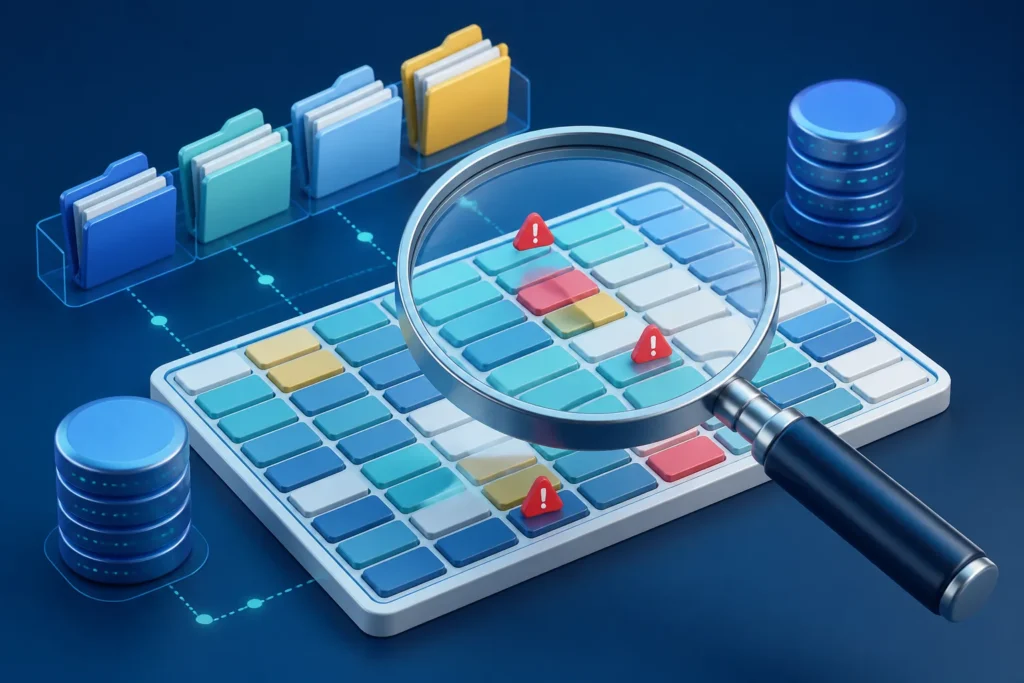
    A sleek magnifying glass hovering over a pristine digital data table, with colorful structured data blocks, labeled folders, database icons, and a few...
    A sleek magnifying glass hovering over a pristine digital data table, with colorful structured data blocks, labeled folders, database icons,…

    What do AI MVP and production-grade project costs and timelines look like?

    Available evidence places small AI projects or proof-of-concept builds at $20,000–$100,000, while full-scale AI product development can exceed several hundred thousand dollars. [3] [1] [8] Keep build costs separate from recurring model API costs: calls to GPT-4o or Claude can add significantly to ongoing costs. [1] [2] [8] [3]

    Full-time hires fit continuous core-product work, while contractors suit short, defined tasks such as prototypes, audits, or integrations. [6] For an external company, meet the actual assigned team, request relevant production experience, test plain-English communication, and consider a paid trial sprint or discovery phase. [1] [2]

    What technical specifications should an AI developer proposal address?

    A technical specification should describe the user workflow and require the candidate to justify whether the system should fine-tune a model, build a retrieval pipeline, or call an existing API. [6] [8] [5] [1] [10] Add latency, accuracy, availability, compute, and cost targets only where your project has established them; the available claims provide no universal target values. For custom AI chatbots, GPT or Claude integrations, AI-powered websites, or knowledge systems, specify how the integration will be tested in the real user workflow.

    Which AI project risks and trade-offs belong in the scope?

    An AI risk register should cover data problems, model drift, accuracy, ongoing costs, hallucinations, silent degradation, and unintended consequences. [1] [10] Treat hallucinations as a fundamental characteristic of AI rather than assuming ordinary defect handling will remove the risk. [1] [5] [10] Require monitoring, model versioning, experiment tracking, workflow documentation, and a named maintenance owner. Tools such as MLflow, Weights & Biases, and DVC are identified as ways to track experiments, manage versions, and document workflows. [9] [1] [2] [6] Test cases should include representative successful inputs, known failure conditions, integration behavior, and the operational signals needed after launch. The available claims don’t provide universal accuracy or latency thresholds, so your acceptance values must come from the established project baselines.

    Evaluate production readiness through a portfolio conversation about a system shipped to production, a realistic scoped exercise, and a system-design interview covering scalable AI pipelines and existing-software integration. [6] [8] Where relevant, assess Python, algorithm implementation, machine-learning frameworks, data pipelines, and production operations. [8]

    Finally, specify post-launch defect handling, support expectations, and the first days. One first-party example covers defect fixes during a 90-day support period. [2]

    Find your new How To Scope A Custom AI Project Before Hiring A Developer on this page.

    AI Project Developer Salary and Cost Comparisons (USD) (compiled from sources)
    Developer Type or Role Salary Range or Cost Source / Claim
    Junior Developer [3] $40–60k per year [3] Junior developers may start around $40–60k per year [3]
    Senior Specialist or Consultant [3] $100k+ annually [3] Senior specialists in fields like computer vision or consultants can command $10 [3]
    Full-time Mid-level AI Engineer [6] $120k–$185k base salary [6] A full-time mid-level hire typically costs $120k–$185k base salary [6]
    Freelance or Contract AI Engineer Hourly [6] $75–$300+ per hour [6] Contract or freelance AI engineers commonly priced at $75–$300+ per hour [6]
    Average AI Engineer Salary [6] $143,000 (Glassdoor) to $185,000 (Built In base), total compensation ~$211,000 [6] Glassdoor reports COVID average AI engineer salary $143,000/year; Built In repor [6]
    Project category Indicative timeline Cost evidence
    Simple integration 4–6 weeks Timeline only; no complete cost range provided
    Custom AI system 8–12 weeks Timeline only; no complete cost range provided
    Enterprise solution 3–6 months Timeline only; no complete cost range provided

    Key Takeaways

    • Start with a measurable business outcome and five to seven core metrics.
    • Separate discovery, data preparation, integration, model training, deployment, and maintenance in the estimate.
    • Choose hiring coverage based on project breadth and the skills your organisation can provide.
    • Require model abstraction, explicit intellectual-property terms, monitoring, and a named maintenance owner.
    • Evaluate candidates with a working slice, realistic test cases, and a documented first days.

    Frequently Asked Questions

    What is the 30% rule for AI?

    No supported definition of the “30% rule for AI” appears in the provided claims. The rule is therefore unknown from the available evidence.

    What is the/20-70 rule for AI?

    No supported definition of the “10/20-70 rule for AI” appears in the provided claims. Its meaning is unknown from the available evidence.

    What is a $900000 AI job?

    The provided claims don’t define a $900,000 AI job or identify a role with that value. The answer is unknown from the available evidence.

    Which jobs will survive AI?

    The provided claims don’t identify three jobs that will survive AI. The answer is unknown from the available evidence.

    Sources

    1. 15 Questions Before Hiring an AI Developer (2025-12-30)
    2. How to Hire an AI Developer in — Capital Compute (2026-09-17)
    3. Find the Best Talent for Your Project (2026-09-19)
    4. The AI Metrics That Drive Real Business Value (2026-01-09)
    5. How to Hire AI Developers in 2026: Vetting, Costs, and Sourcing Strategies
    6. How to Hire an AI Engineer for Your Project (2026-06-25)
    7. Project scope — definition, examples, and templates
    8. How to hire AI Developers that drive real impact
    9. 10 AI Project Ideas for Better Project Scoping (2026-04-13)
    10. Feasibility | The Measures Management System (2024-07-29)
Read the whole story
ebbuapp
13 days ago
reply
United States
Share this story
Delete